9 Information inside the body
Chapter 8 showed that, in a body shaken by its own thermal noise, the whole body holds the same information about the contact force in every design, and that designs differ in how much of it a given part holds. This chapter asks what decides that, and what erodes the information on its way from the contact to a part.
The answers, in plain terms:
- Only internal dampers lose information. A part holds the contact force as if the contact damping were larger than it is. The increase comes entirely from dampers inside the body. Springs and masses matter only through how they shape those dampers’ noise at the part. With no internal damper, every part holds everything (Section 9.1).
- Push on the part to find the cost. Push on the part and watch the body. Each internal damper costs its damping times the square of its stretch per unit motion of the contact point. A part with several coordinates gets to pick the best way to be pushed (Section 9.2).
- Losses build up along the path from the contact. At low frequency each damper on that path costs \(b_j(k_c/k_j)^2\), so a body that is stiff inside compared with its contact keeps the force intact. Dampers off the path, beyond the part or in side branches, cost nothing at low frequency but feed noise back in band. The contact point itself can hold the least, near the natural frequencies of the body held fixed at the contact (Section 9.3).
- With two feet down, the total load and the split differ. The body knows the total load as well as the contact dampers allow. Knowing how the load is split between the feet also pays for the dampers on the path between them (Section 9.4).
- Other properties of the environment propagate the same way inside the body. The height of the ground reaches the body through the contact as a filtered force. Inside the body each part holds the same fraction of it as of the force. At the contact the two questions part ways: stiffer ground helps the body know the height and does nothing for the force (Section 9.5).
The results were first recorded as dated research notes, which the research log keeps. Every number is computed by mibook and pinned by the tests named above.
9.1 Parts of the body and the effective contact damping
9.1.1 Definitions
Take the Langevin body of Chapter 8: thermal forces with covariance \(2\sigma_T^2D\), started from the Gibbs law. Split the damping into the contact damper and everything else, \[ D=b_c\,J^\top J+D_{\rm int},\qquad D_{\rm int}\succeq0 . \] For the legs in this book \(b_c=b_i=600\) N s/m. For the rigid leg \(D_{\rm int}=0\). For the SEA, \(D_{\rm int}\) is the series damper \(b_s\) acting on the spring deflection.
A part of the body is a set of its coordinates, \(x_P=Px_q\) for a selector matrix \(P\). The rotor’s angle and velocity form one part; the joint-side link’s angle and velocity form another. Nothing is added to \(x_P\): the only noise is the body’s own.
Definition 9.2 (Effective contact damping) At frequency \(\omega\), let \(h(\omega)=P(i\omega-A)^{-1}B_F\) be the part’s response to the contact force and \(G(\omega)=P(i\omega-A)^{-1}[0;H^{-1}]\) its response to a generalized force. Let \[ M(\omega)=2\sigma_T^2\,G\,D_{\rm int}\,G^* \] be the thermal noise the part receives from the internal dampers, and \(q(\omega)=h^*M^+h\), with \(q=\infty\) when \(h\) lies outside the range of \(M\). The effective contact damping is \[ b_{\rm eff}(\omega)=b_c+\frac{1}{2\sigma_T^2\,q(\omega)}, \] and the spectral share is \(\rho(\omega)=b_c/b_{\rm eff}(\omega)\).
Proof.
The part is a function of the whole state, so data processing gives \(I(w;x_P)\le I(w;x_q)\). For \(\rho\): \(q\ge0\) because \(M\succeq0\), so \(b_{\rm eff}\ge b_c\).
A larger part contains the smaller one’s trajectory, so data processing again gives the inequality for \(\eta\). For \(\rho\), appending rows to \(P\) can only increase \(h^*M^+h\), the signal-to-noise ratio of the best linear combination of the rows.
Under \(q=T\tilde q\) the trajectories and the thermal forces are the same physical signals written in other coordinates (Theorem 2.1), so every information quantity is unchanged. The transfer functions \(h\) and \(G\,D_{\rm int}G^*\) are unchanged for the same reason.
Replacing \(P\) by \(SP\) with \(S\) invertible maps \(h\mapsto Sh\) and \(M\mapsto SMS^*\), which leaves \(h^*M^+h\) unchanged. \(M\) is proportional to \(\sigma_T^2\), so \(\sigma_T^2q\) and hence \(b_{\rm eff}\) do not depend on \(\sigma_T\). The prior does not appear at all.
In the frequency domain a velocity is \(i\omega\) times its coordinate, so the part (coordinate, velocity) has \(h=v\,h_\theta\) and \(M=v\,M_\theta\,v^*\) with \(v=(1,i\omega)^\top\). Then \(M^+=v v^*/(M_\theta|v|^4)\), and \(h^*M^+h=|h_\theta|^2/M_\theta\), the value for the coordinate alone. Thermal noise moves the velocity and the coordinate together, so the velocity adds no independent look at the force.
Theorem 9.1 (A part holds the force through an effective damper) In the stationary, infinite-window limit, with force spectrum \(S(\omega)\), the information rate held by the part is \[ \dot I_P=\int_0^{\infty}\log\Big(1+\frac{S(\omega)}{2\sigma_T^2\,b_{\rm eff}(\omega)}\Big)\, \frac{d\omega}{2\pi}\ \text{nats/s}, \] and the whole body’s rate is the same expression with \(b_{\rm eff}=b_c\).
Proof. Step 1: the contact damper’s noise enters like the force. The thermal forces have covariance \(2\sigma_T^2D=2\sigma_T^2(b_cJ^\top J+D_{\rm int})\). In law they equal \(J^\top\xi_c+\xi_{\rm int}\), with \(\xi_c\) a scalar white noise of intensity \(2\sigma_T^2b_c\) and \(\xi_{\rm int}\) an independent white noise of covariance \(2\sigma_T^2D_{\rm int}\). Since \(f\) also enters through \(J^\top\), the part’s trajectory is \[ x_P=h\,(f+\xi_c)+G\,\xi_{\rm int} . \]
Step 2: one frequency. At each frequency this is a scalar Gaussian signal \(f\) in Gaussian noise of spectral density \(N=2\sigma_T^2b_c\,hh^*+M\). The information rate of a stationary Gaussian signal in independent stationary Gaussian noise is the integral of \(\log(1+S\,h^*N^{-1}h)\) over frequency (Cover and Thomas 2006, Ch. 9).
Step 3: Sherman-Morrison. With \(u=\sqrt{2\sigma_T^2b_c}\,h\), \((M+uu^*)^{-1}=M^{-1}-M^{-1}uu^*M^{-1}/(1+u^*M^{-1}u)\), so \[ h^*N^{-1}h=\frac{q}{1+2\sigma_T^2b_c\,q}=\frac{1}{2\sigma_T^2b_c+1/q} =\frac{1}{2\sigma_T^2b_{\rm eff}} . \] When \(M\) is singular the same holds with \(M^+\), and \(q=\infty\) gives \(b_{\rm eff}=b_c\).
Step 4: the whole body. With \(P=I\), \(h=G\,J^\top\) and \(M=2\sigma_T^2GD_{\rm int}G^*\). The matrix \(G=(i\omega-A)^{-1}[0;H^{-1}]\) has full column rank, so \(h\) lies in the range of \(M\) exactly when \(J^\top\) lies in the range of \(D_{\rm int}\). For the rigid leg \(D_{\rm int}=0\). For the SEA its range is spanned by \((1,-1)\), which does not contain \(J^\top=(-r,0)\). So \(q=\infty\) and \(b_{\rm eff}=b_c\), consistent with Proposition 8.2.
Corollary 9.1 (No internal damper, no loss) If the only damper is at the contact (\(D_{\rm int}=0\)) and \(h(\omega)\ne0\) over the force band, then \(\rho\equiv1\): every part holds everything the body holds. In the rigid leg the rotor’s angle alone holds the full ceiling, and so does its velocity alone.
Proof. \(M=0\), so \(h\) lies outside the range of \(M\) wherever \(h\ne0\), and \(b_{\rm eff}=b_c\).
Proposition 9.2 (The SEA’s rotor and link) For the clamped SEA with series damping \(b_s=2\zeta_s\sqrt{k_sI_{\rm rot}}\), \(m_j=m_lr^2\) and \(c=k_s+ib_s\omega\), \[ \rho_{\rm rotor}=\Big[1+\frac{b_s}{b_c}\, \frac{|k_ir^2-m_j\omega^2+i\omega b_cr^2|^2}{r^2|c|^2}\Big]^{-1},\qquad \rho_{\rm link}=\Big[1+\frac{b_s}{b_c}\, \frac{I_{\rm rot}^2\omega^4}{r^2|c-I_{\rm rot}\omega^2|^2}\Big]^{-1}. \]
Proof. By Proposition 9.1(e) it is enough to work with each part’s angle.
Step 1: the impedance matrix. With \(z_g=k_ir^2+i\omega b_cr^2-m_j\omega^2\) the joint-side impedance, the clamped equations read \(Z q=J^\top f+\dots\) with \(Z=\left[\begin{smallmatrix}z_g+c&-c\\-c&-I_{\rm rot}\omega^2+c\end{smallmatrix}\right]\) and \(\Delta=\det Z\), so \(Z^{-1}=\Delta^{-1}\left[\begin{smallmatrix}-I_{\rm rot}\omega^2+c&c\\c&z_g+c \end{smallmatrix}\right]\).
Step 2: the two inputs. The contact force enters as \(J^\top=(-r,0)\). The series damper acts on the deflection, so its noise enters as \(a_s=(1,-1)\) with intensity \(2\sigma_T^2b_s\).
Step 3: the rotor is row 2 of \(Z^{-1}\): \(h=-rc/\Delta\) and \(h_s=(c-z_g-c)/\Delta=-z_g/\Delta\). With one coordinate, \(1/(2\sigma_T^2q)=b_s|h_s|^2/|h|^2=b_s|z_g|^2/(r^2|c|^2)\).
Step 4: the link is row 1: \(h=-r(c-I_{\rm rot}\omega^2)/\Delta\) and \(h_s=(c-I_{\rm rot}\omega^2-c)/\Delta=-I_{\rm rot}\omega^2/\Delta\), which gives \(b_s|h_s|^2/|h|^2=b_sI_{\rm rot}^2\omega^4/(r^2|c-I_{\rm rot}\omega^2|^2)\).
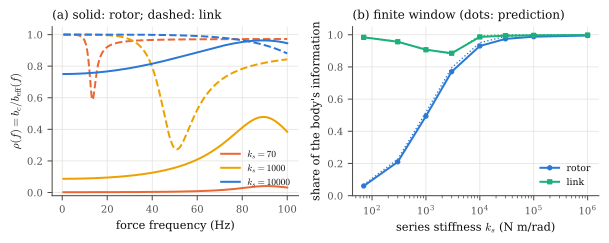
The two formulas say where the series damper’s noise lands. The rotor sits behind the damper, so it receives the damper’s noise against the force filtered through the spring, and a soft spring makes that filter weak. The link sits on the contact side. Its losses come only near the rotor resonance \(\sqrt{k_s/I_{\rm rot}}\), where the rotor swings and pumps the damper’s noise back through the spring.
Proposition 9.3 (At low SNR, the share is the band average of rho) With a flat force spectrum over \([0,B]\) and whole-body SNR \(\mathrm{snr}=S/(2\sigma_T^2b_c)\), the infinite-window share is \(\eta=\int_0^B\log(1+\mathrm{snr}\,\rho)\,df\big/\big(B\log(1+\mathrm{snr})\big)\), and \(\eta\to\frac1B\int_0^B\rho\,df\) as \(\mathrm{snr}\to0\).
Proof. The formula for \(\eta\) is Theorem 9.1 divided by its whole-body value. As \(\mathrm{snr}\to0\), \(\log(1+\mathrm{snr}\,\rho)/\log(1+\mathrm{snr})\to\rho\) for each \(f\), and the ratio is bounded by 1, so the limit passes inside the integral (dominated convergence).
So \(\rho(\omega)\) describes the body and the part without reference to a noise level or a force prior, and \(\eta\) is that description at a stated SNR. A larger SNR compresses the losses, because the logarithm saturates.
9.1.2 The SEA in numbers
| \(k_s\) (N m/rad) | rotor, finite | rotor, predicted | link, finite | link, predicted |
|---|---|---|---|---|
| 70 | 0.060 | 0.068 | 0.984 | 0.985 |
| \(10^3\) | 0.494 | 0.518 | 0.907 | 0.910 |
| \(10^4\) | 0.930 | 0.951 | 0.986 | 0.994 |
| \(10^6\) | 0.995 | 1.000 | 0.998 | 1.000 |
- The state-space computation and the closed forms agree to \(7\times10^{-16}\), and \(\rho\) is unchanged, to \(4\times10^{-16}\), under every reparametrization of Figure 2.1 (
check_closed_forms,check_reparametrization). - The finite-window share sits up to 0.025 below the prediction. The gap comes from the window’s edges and from the Gibbs initial state, and shrinks as \(k_s\) grows (
check_prediction). - Series damping is the loss. At \(k_s=70\), lowering \(\zeta_s\) from 0.1 to 0.03 to 0.01 raises the rotor’s share from 0.060 to 0.095 to 0.200, while the whole body stays at 37.742 bits (
check_series_damping). - At low SNR the share tends to the band average of \(\rho\): 0.221 for the rotor at \(k_s=10^3\), against 0.518 at the book’s SNR (
check_low_snr_limit).
9.2 Push on the part
The SEA has one internal damper. To handle bodies with many, take any linear body with symmetric \(H\), \(K\) and \(D\) whose dampers are independent: \[ D=b_c\,J^\top J+\sum_j b_j\,a_ja_j^\top , \] where damper \(j\) resists the velocity \(a_j^\top\dot q\) with coefficient \(b_j\). A part is one combination of coordinates \(y=p^\top q\), such as a node or a spring’s deflection. By Proposition 9.1(e) its velocity adds nothing, so one row is enough. The dynamic stiffness at frequency \(\omega\) is \[ Z(\omega)=K-\omega^2H+i\omega D , \] and \(Z(\omega)^{-1}\) maps a harmonic force to the harmonic displacement it produces. This is the position block of \((i\omega-A)^{-1}[0;H^{-1}]\) in Definition 9.2.
Theorem 9.2 (Shake the body at the part) Let \(w(\omega)=Z(\omega)^{-1}p\) be the body’s response to a unit harmonic force applied at the part. Then \[ b_{\rm eff}(\omega)=b_c+\sum_j b_j\,\frac{|a_j^\top w|^2}{|Jw|^2}. \]
Proof. Step 1: the two responses. At frequency \(\omega\) the part responds to the contact force with \(h=p^\top Z^{-1}J^\top\) and to the noise force of damper \(j\), which enters along \(a_j\), with \(p^\top Z^{-1}a_j\).
Step 2: the definition. The dampers are independent, so the noise the part receives from them is \(M=2\sigma_T^2\sum_jb_j|p^\top Z^{-1}a_j|^2\). With one coordinate, \(q=|h|^2/M\), and the definition of \(b_{\rm eff}\) gives \[ b_{\rm eff}-b_c=\frac{1}{2\sigma_T^2q}=\sum_jb_j\,\frac{|p^\top Z^{-1}a_j|^2}{|p^\top Z^{-1}J^\top|^2}. \]
Step 3: reciprocity. \(Z\) is a symmetric complex matrix (not Hermitian), so \(Z^{-1}\) is symmetric too. Hence \(p^\top Z^{-1}a_j=a_j^\top Z^{-1}p=a_j^\top w\) and \(p^\top Z^{-1}J^\top=JZ^{-1}p=Jw\). This is the Maxwell-Betti reciprocity theorem of structural mechanics: the response at the part to a force at the damper equals the damper’s stretch under a force at the part.
The formula turns a question about noise into a question about one forced motion. Push on the part and watch the body: a damper that stretches a lot while the contact point barely moves is expensive. The numerical check uses 20 random chains with 2 to 8 nodes and parameters spread over several decades, plus the SEA’s rotor, link and spring deflection. The formula and the state-space computation of \(b_{\rm eff}\) agree to \(4\times10^{-14}\) on the chains and \(10^{-10}\) on the SEA (check_reciprocity).
9.2.1 Parts with several coordinates
A part may have \(m\) coordinates, \(y=Pq\) with \(P\) an \(m\times n\) matrix, such as two masses at once. By Proposition 9.1(e), velocities add nothing, so positions are enough. A force pattern on the part is a vector \(\phi\in\mathbb C^m\); it applies the generalized force \(P^\top\phi\), and the body responds with \(x(\phi)=Z^{-1}P^\top\phi\).
Theorem 9.3 (The part chooses how it is pushed) \[ b_{\rm eff}(\omega)=b_c+\min_{\phi}\ \sum_jb_j\,\frac{|a_j^\top x(\phi)|^2}{|J\,x(\phi)|^2}, \] the minimum taken over patterns that move the contact point. With \(W=Z^{-1}P^\top\), \(h=W^\top J^\top\), \(s_j=W^\top a_j\) and \(N=\sum_jb_js_js_j^*\), the minimum equals \(1/(h^*N^+h)\) and is reached at \(\phi=\overline{N^+h}\). If \(h\) lies outside the range of \(N\), some pattern moves the contact point without stretching any internal damper, the minimum is 0, and \(b_{\rm eff}=b_c\).
Proof. Step 1: reciprocity. The part’s response to the contact force is \(PZ^{-1}J^\top\) and to damper \(j\)’s noise force \(PZ^{-1}a_j\). \(Z^{-1}\) is symmetric, so these are \(W^\top J^\top=h\) and \(W^\top a_j=s_j\). For any pattern, \(h^\top\phi=JW\phi=Jx(\phi)\) and \(s_j^\top\phi=a_j^\top x(\phi)\).
Step 2: the definition. The part receives internal noise \(M=2\sigma_T^2N\), so \(q=h^*M^+h=h^*N^+h/(2\sigma_T^2)\) and \(b_{\rm eff}-b_c=1/(2\sigma_T^2q)=1/(h^*N^+h)\).
Step 3: Cauchy-Schwarz. \(N\) is Hermitian and positive semidefinite. If \(h\) is in its range, then \(h=N^{1/2}(N^{+})^{1/2}h\), and for any \(\psi\) \[ |h^*\psi|^2=\big|\big((N^+)^{1/2}h\big)^*\,N^{1/2}\psi\big|^2\le(h^*N^+h)\,(\psi^*N\psi), \] with equality at \(\psi=N^+h\). So \(\max_\psi|h^*\psi|^2/(\psi^*N\psi)=h^*N^+h\). If \(h\) is outside the range, take \(\psi\) in the null space of \(N\) with \(h^*\psi\ne0\): the ratio is unbounded, and \(q=\infty\) as in Definition 9.2.
Step 4: back to patterns. Put \(\psi=\bar\phi\). Then \(|h^*\psi|=|h^\top\phi|=|Jx|\) and \(\psi^*N\psi=\sum_jb_j|s_j^\top\phi|^2=\sum_jb_j|a_j^\top x|^2\). The maximum of the ratio in Step 3 is one over the minimum cost.
For one coordinate there is only one pattern, and the theorem reduces to Theorem 9.2. Two consequences come straight from the minimum:
- More coordinates never hurt. Adding coordinates to the part enlarges the set of patterns, so the minimum can only fall. This is a second proof of Proposition 9.1(b).
- When a part holds everything. If some pattern moves the contact point without stretching any internal damper, the part holds the whole body’s information at that frequency. For the whole body every force is allowed, so this is possible exactly when \(J^\top\) is not in the span of the \(a_j\), the condition of Proposition 8.2. The SEA’s rotor and link together hold everything: push both so that they move together, and the series damper never stretches.
The formula matches the state-space \(b_{\rm eff}\) to \(4\times10^{-11}\) on random chains with parts of two or three nodes. In 200 random patterns per case, none did better than the predicted best, which reaches the minimum to \(10^{-10}\) (check_matrix_reciprocity).
9.2.2 Example: the SEA’s spring deflection
Proposition 9.4 (The deflection holds the force only through the rotor) For the clamped SEA with the motor undriven, the spring deflection \(\delta=\theta_j-\theta_m\) has \[ \rho_\delta=\Big[1+\frac{b_s}{b_c}\, \frac{|k_ir^2-m_j\omega^2+i\omega b_cr^2-I_{\rm rot}\omega^2|^2}{r^2I_{\rm rot}^2\omega^4}\Big]^{-1}, \] which tends to 0 as \(\omega\to0\). The spring stiffness \(k_s\) enters only through \(b_s\).
Proof. Apply Theorem 9.2 with \(p=(1,-1)\): equal and opposite torques across the spring. With \(z_g=k_ir^2+i\omega b_cr^2-m_j\omega^2\) and \(c=k_s+i\omega b_s\), \(Zw=p\) reads \[ (z_g+c)w_0-c\,w_1=1,\qquad -c\,w_0+(c-I_{\rm rot}\omega^2)w_1=-1 . \] Adding the two rows gives \(z_gw_0=I_{\rm rot}\omega^2w_1\). The damper’s stretch is \(w_0-w_1=w_0(I_{\rm rot}\omega^2-z_g)/(I_{\rm rot}\omega^2)\) and the contact moves by \(Jw=-rw_0\), so the cost is \(b_s|z_g-I_{\rm rot}\omega^2|^2/(r^2I_{\rm rot}^2\omega^4)\). Neither expression contains \(c\), so \(k_s\) appears only inside \(b_s\).
Pinching the spring with equal and opposite torques barely moves the foot when the rotor is free, because the rotor’s inertia is the only thing the spring can push against. So the deflection follows the contact force only through the rotor’s acceleration, which vanishes at low frequency. Its share falls with stiffness, from 0.566 at \(k_s=70\) to 0.463 at \(10^3\) and 0.362 at \(10^4\) (predicted 0.597, 0.492, 0.389), because a stiffer spring at fixed damping ratio has a larger \(b_s\). The closed form matches the state-space computation to \(10^{-15}\) (check_deflection). A driven motor changes this, since the motor torque then also balances the spring.
9.3 Chains, rods and trees
A chain has node 0 at the contact, where the force acts and the ground holds it through a spring \(k_c\) and a damper \(b_c\). Element \(j\) joins node \(j\) to node \(j+1\) with a spring \(k_j\) and a damper \(b_j\), so \(a_j=e_j-e_{j+1}\). The far end is free.
Corollary 9.2 (Costs accumulate along a chain) In a chain, take a part at node \(k\) and an element \(j<k\), which lies between the contact and the part. Its cost \(|a_j^\top w|^2/|w_0|^2\) is the same for every part \(k>j\). So \[ b_{\rm eff,k}=b_c+\sum_{j<k}b_j\,c_j+B_k , \] where \(c_j\) does not depend on \(k\), and the backflow \(B_k\) collects the elements beyond node \(k\).
Proof. \(w\) solves \(Zw=e_k\), and \(Z\) is tridiagonal. Rows \(0,\dots,k-1\) of this system have zero on the right. Row 0 reads \(Z_{00}w_0+Z_{01}w_1=0\), which fixes \(w_1/w_0\); the off-diagonal entry \(Z_{01}=-(k_0+i\omega b_0)\) is nonzero. Each further row \(i\le k-1\) fixes \(w_{i+1}\) from \(w_{i-1}\) and \(w_i\). So the ratios \(w_1/w_0,\dots,w_k/w_0\) come from rows that do not involve \(k\), and \((w_j-w_{j+1})/w_0\) is the same for every \(k\ge j+1\).
The ratio \(|a_j^\top w|^2/|w_0|^2\) agrees across parts to \(10^{-14}\) on the uniform chain below (check_accumulation). Once information has been lost crossing a damper, no part farther along gets it back. The share can still rise along the chain, because the backflow \(B_k\) shrinks as fewer dampers lie beyond the part.
Proposition 9.5 (The static law) In a chain with a free far end, \[ \rho_k(0)=\frac{b_c}{b_c+k_c^2\sum_{j<k}b_j/k_j^2}. \]
Proof. At \(\omega=0\), \(Z=K\), which is invertible because the contact spring anchors the chain, and \(w\) is the static deflection under a unit force at node \(k\).
- The segment beyond node \(k\) is free and unloaded, so its springs carry no force and \(a_j^\top w=0\) for \(j\ge k\). The backflow is zero.
- Every element between the contact and node \(k\) carries the whole unit force, so it stretches by \(1/k_j\).
- The contact spring carries it too, so \(w_0=1/k_c\).
Theorem 9.2 then gives \(b_{\rm eff,k}(0)=b_c+\sum_{j<k}b_j\,k_c^2/k_j^2\).
Each damper on the way costs \(b_j(k_c/k_j)^2\). Since \(b_j/k_j\) is the damper’s relaxation time, this cost is the relaxation time multiplied by \(k_c^2/k_j\): it grows with slow dampers and with springs that are soft compared with the contact. For the SEA’s rotor, in joint coordinates where the contact has stiffness \(k_ir^2\) and damping \(b_cr^2\), the law gives the cost \(b_s(k_ir^2/k_s)^2\), the low-frequency limit of Proposition 9.2. On 20 random chains the law matches \(\rho_k\) at \(10^{-4}\) Hz to \(2\times10^{-10}\) (check_static_law).
For a rod with Kelvin-Voigt material damping \(D=cK\), an element of length \(h\) has \(k_e=EA/h\) and \(b_e=c\,EA/h\), so it costs \(c\,k_c^2h/EA\). The elements between the contact and a point at distance \(x\) add up to \[ \rho(x,0)=\frac{b_c}{b_c+c\,k_c^2\,x/EA}, \] which does not depend on the mesh.
Remark 9.1 (Where the contact point loses). For the part at the contact node, \(w=Z^{-1}e_0\), and by Cramer’s rule \(w_0=\det Z_c/\det Z\), where \(Z_c\) is \(Z\) with row and column 0 removed: the dynamic stiffness of the body held fixed at the contact. Near a natural frequency of that clamped body, \(\det Z_c\) is small (zero without internal damping). The rest of the body then rings while the contact point hardly moves, and the cost in Theorem 9.2 becomes large. On the SEA, the clamped body is the rotor on its spring, which is why the link loses near \(\sqrt{k_s/I_{\rm rot}}\).
9.3.1 A uniform chain and a rod
The uniform chain has eight 0.1 kg masses, springs of \(10^4\) N/m, dampers at 5% of critical per element, and a contact ten times stiffer than one element (\(k_c=10^5\) N/m, \(b_c=84.9\) N s/m, 15% of critical on the chain’s mass). Its modes lie between 10 and 168 Hz, and the whole body holds 61.23 bits about a 100 Hz force profile. The rod is free at both ends and touches the ground at one: \(L=0.2\) m, \(EA=10^3\) N, \(\rho A=0.1\) kg/m, Kelvin-Voigt damping at 5% of critical on the first free-free mode, \(k_c=EA/L\) and \(b_c=3\) N s/m.
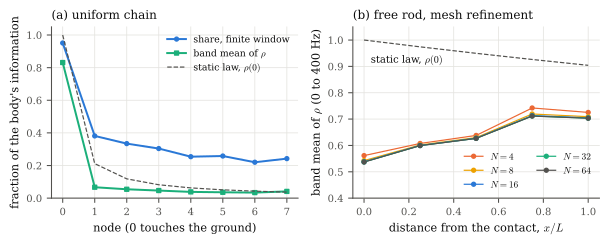
check_chain_shares).
| Node | 0 | 1 | 2 | 3 | 4 | 5 | 6 | 7 |
|---|---|---|---|---|---|---|---|---|
| share, finite window | 0.951 | 0.381 | 0.334 | 0.304 | 0.254 | 0.258 | 0.220 | 0.242 |
| band mean of \(\rho\) | 0.831 | 0.067 | 0.054 | 0.047 | 0.038 | 0.036 | 0.034 | 0.041 |
| static law \(\rho(0)\) | 1 | 0.212 | 0.118 | 0.082 | 0.063 | 0.051 | 0.043 | 0.037 |
- The first damper costs most. The contact is ten times stiffer than one element, so each damper costs \(b_j(k_c/k_j)^2=100\,b_j\) statically, about four times \(b_c\). The share drops from 0.951 at the contact node to 0.381 one node in, then declines slowly.
- The free end beats its neighbour. Node 7 holds 0.242 and node 6 holds 0.220. Node 7 has no damper beyond it, so its backflow is zero; node 6 still receives the last damper’s noise from behind.
- The finite-window share sits far above the band mean of \(\rho\). The whole-body SNR is 147 per band, and the logarithm in Proposition 9.3 compresses the losses.
- The rod converges under mesh refinement. From 32 to 64 elements the band mean of \(\rho\) changes by at most \(4\times10^{-4}\) at every position, and the static values match the formula above to \(10^{-6}\) on every mesh (
check_rod_mesh). - On the rod the contact point holds the least. The band mean of \(\rho\) is 0.537 at the contact and rises to 0.711 at \(x=0.75L\) and 0.703 at the far end, while the static law falls from 1 to 0.904. The contact node’s \(\rho\) dips to 0.012 at 125.1 Hz and to 0.092 at 377.5 Hz; the rod clamped at the contact has its modes at 125.0 and 375.3 Hz (
check_contact_dips). The chain’s two deepest dips sit at 10.53 and 31.13 Hz, against clamped modes at 10.52 and 31.11 Hz.
9.3.2 Groups of nodes, bridges and trees
Proposition 9.6 (A group holds statically what its nearest node holds) In a chain with a free far end, let \(S\) be a set of nodes and \(s\) its node nearest the contact. Then \(\rho_S(0)=\rho_s(0)\).
Proof. At \(\omega=0\) apply forces \(\phi_i\) at the nodes \(i\in S\), with total \(F=\sum_i\phi_i\ne0\). The segment beyond element \(j\) is free, so element \(j\) carries the sum of the forces beyond it, \(F_j=\sum_{i\in S,\,i>j}\phi_i\), and stretches by \(F_j/k_j\). The contact spring carries \(F\), so the contact point moves \(F/k_c\). The cost is \(k_c^2\sum_jb_j|F_j|^2/(k_j^2|F|^2)\).
- For \(j<s\), every node of \(S\) lies beyond element \(j\), so \(F_j=F\). These terms give \(k_c^2\sum_{j<s}b_j/k_j^2\) whatever the pattern.
- For \(j\ge s\) the terms are nonnegative, and they all vanish when the whole force is put at node \(s\).
So the minimum is \(k_c^2\sum_{j<s}b_j/k_j^2\), the static cost of node \(s\) alone (Proposition 9.5).
Statically, a farther node gives the group nothing, because its forces must pass through every damper the nearest node’s forces pass through. In band it can help: the far node lets the part cancel some of the backflow. On the uniform chain of Table 9.2, node 1 holds 0.381 of the body’s information, node 7 holds 0.242, and the two together hold 0.499. Nodes 6 and 7 together hold 0.283, against 0.220 and 0.242 alone (check_pairs). The static law for groups holds on random chains to \(4\times10^{-11}\) (check_set_static_law).
Proposition 9.7 (Everything before a bridge costs the same) Call an element a bridge if removing it splits the body into a side \(C\) that contains the contact node and a side \(F\), with the element the only connection between them (no spring, damper or mass coupling otherwise). Let \(c\in C\) and \(f\in F\) be its two nodes. For every force pattern applied on nodes of \(F\), the cost \(|a_j^\top x|^2/|Jx|^2\) of each damper inside \(C\), and of the bridge’s own damper, is the same.
Proof. The forces act only on \(F\), so the rows of \(Zx=\) (force) for the nodes of \(C\) have zero on the right. In those rows, \(F\) appears only through the bridge, in row \(c\), as \(Z_{cf}x_f\) with \(Z_{cf}=-(k_e+i\omega b_e)\). So \[ Z_{CC}\,x_C=-Z_{cf}\,x_f\,e_c ,\qquad x_C=-Z_{cf}\,x_f\,Z_{CC}^{-1}e_c . \] Every motion on the contact side is a fixed multiple of \(x_f\), and so is the bridge’s stretch \(x_c-x_f\). Every ratio of these motions to the contact motion \(x_0\) is therefore fixed. \(Z_{CC}\) is invertible for \(\omega>0\): if \(Z_{CC}v=0\), the imaginary part of \(v^*Z_{CC}v\) is \(\omega\,v^*D_{CC}v=0\). That forces \(v_0=0\) through the contact damper, and equal motion across every damper of the connected side \(C\), so \(v=0\).
This is the general form of Corollary 9.2: \[
b_{\rm eff}=b_c+\underbrace{\text{(cost of the contact side)}}_{\text{same for every part beyond}}
+\min_{\phi}\,\text{(cost of the far side)} .
\] In a chain every element is a bridge. In a tree, every element on the path from the contact to the part is one. On the leg-on-trunk body below, the hip-trunk element is a bridge, and the costs of the three dampers up to and including it agree to \(3\times10^{-15}\) across single nodes and 20 random patterns beyond it (check_bridge).
Proposition 9.8 (In a tree, only the path matters statically) In a body whose elements form a tree, with only the contact node attached to the ground, \[ \rho_k(0)=\frac{b_c}{b_c+k_c^2\sum_{j\in\text{path}(k)}b_j/k_j^2}, \] where \(\text{path}(k)\) holds the elements between the contact and node \(k\).
Proof. Apply a static unit force at node \(k\). Every branch off the path ends in free nodes, so it is unloaded and its elements do not stretch. Every element on the path carries the whole force and stretches by \(1/k_j\), and the contact point moves \(1/k_c\). Theorem 9.2 then gives the formula.
9.3.3 A leg on a trunk
The toy body is one-dimensional and vertical. The foot (0.2 kg) is on the ground, with \(k_c=10^5\) N/m and \(b_c=270\) N s/m (15% of critical on the total mass). The knee (0.5 kg), hip (1 kg) and trunk (5 kg) follow, joined by springs of \(2\times10^4\), \(2\times10^4\) and \(5\times10^4\) N/m. Two identical swing legs hang from the trunk, each a knee (0.5 kg) and a foot (0.2 kg) on \(2\times10^4\) N/m springs. Every element is damped at 5% of critical on its lighter mass, and the swing legs at either 5% or 20%.
check_tree). The whole body holds 47.22 bits in both cases.
| Node | foot | knee | hip | trunk | swing knee | swing foot |
|---|---|---|---|---|---|---|
| share, swing legs at 5% | 0.957 | 0.525 | 0.241 | 0.242 | 0.076 | 0.073 |
| share, swing legs at 20% | 0.957 | 0.525 | 0.239 | 0.214 | 0.044 | 0.037 |
| static \(\rho(0)\), 5% | 1 | 0.631 | 0.398 | 0.352 | 0.265 | 0.230 |
| static \(\rho(0)\), 20% | 1 | 0.631 | 0.398 | 0.352 | 0.153 | 0.112 |
- The whole body does not notice the swing legs. It holds 47.22 bits with either swing damping, because the ceiling depends only on the contact damper (Proposition 8.2).
- Statically, the trunk does not notice them either. Its static value is 0.352 in both cases, as Proposition 9.8 says: the swing legs are off its path.
- In band, the trunk does notice. Heavier swing damping lowers the trunk’s share from 0.242 to 0.214. The swing legs ring and feed their dampers’ noise back into the trunk. The hip, one element farther from the swing legs, barely changes (0.241 to 0.239).
- The trunk holds as much as the hip. The hip-trunk spring is stiff and the trunk is heavy, so in band the trunk’s share (0.242) matches the hip’s (0.241). Statically the trunk still pays for one more damper on its path.
9.4 Two feet on the ground
With two feet down there are two unknown forces, the feet share the load, and the body has two routes to the ground. Contact \(i\) is node \(c_i\), held by a ground spring \(k_i\) and damper \(b_i\), and takes its own force \(f_i\). \(J\) has one row per contact, \(B_c=\diag(b_1,b_2)\), and \[ D=J^\top B_cJ+\sum_jb_j\,a_ja_j^\top . \] We assume every node is connected through dampers to a contact, so \(D\) is invertible. The two forces have independent priors of equal size. A part’s information matrix \(F(\omega)\) is the \(2\times2\) matrix with \(2\sigma_T^2F\) equal to the Fisher information about \((f_1,f_2)\) per unit force spectrum. Its information rate is \(\int\log\det\big(I+S\,F/(2\sigma_T^2)\big)\,d\omega/2\pi\). With one contact, \(F=1/b_{\rm eff}\).
Theorem 9.4 (The whole body sees the forces through one damping matrix) The whole body’s information matrix is \(F=JD^{-1}J^\top\) at every frequency. Equivalently, the body sees the forces through the damping matrix \(B=(JD^{-1}J^\top)^{-1}\).
Proof. Step 1: an equivalent observation. At frequency \(\omega\) the body moves as \(Zx=J^\top(f+\xi_c)+\sum_ja_j\xi_j\), where \(\xi_c\) is the contact dampers’ noise and \(\xi_j\) damper \(j\)’s. \(Z\) is invertible, so observing \(x\) is the same as observing \(Zx\): the net force on every mass.
Step 2: the noise. The noise in \(Zx\) is \(J^\top\xi_c+\sum_ja_j\xi_j\). The dampers are independent, so its spectral density is \(2\sigma_T^2(J^\top B_cJ+\sum_jb_ja_ja_j^\top)= 2\sigma_T^2D\), the same at every frequency.
Step 3: the Gaussian channel. The signal \(J^\top f\) in noise of density \(2\sigma_T^2D\) gives the Fisher matrix \(JD^{-1}J^\top/(2\sigma_T^2)\) per unit force spectrum.
With one contact this gives \(F=JD^{-1}J^\top=1/b_c\) for any body whose nodes are all connected through dampers, because the internal dampers seen from a single node have no effect (Step 2 of the corollary below, with one terminal). That is the infinite-window form of Proposition 8.2, here derived without Duncan’s theorem. On 20 random tree-shaped bodies with two contacts, the state-space information matrix of the whole body equals \(JD^{-1}J^\top\) to \(10^{-11}\) at 0.5, 8 and 60 Hz (check_whole_body).
Corollary 9.3 (The path between the feet, in series) For a tree-shaped body with contacts at nodes \(c_1\ne c_2\), \[ B=B_c+b_\times\begin{pmatrix}1&-1\\-1&1\end{pmatrix},\qquad b_\times=\Big(\sum_{j\in\text{path}(c_1,c_2)}\frac1{b_j}\Big)^{-1}. \] With equal contacts (\(b_1=b_2=b_c\)), the total load \((f_1+f_2)/\sqrt2\) is seen through \(b_c\) and the split \((f_1-f_2)/\sqrt2\) through \(b_c+2b_\times\).
Proof. Step 1: a Schur complement. Order the nodes as contacts, then the rest. By the block inverse formula, the contact block of \(D^{-1}\), which is \(JD^{-1}J^\top\), is the inverse of the Schur complement \(D_{cc}-D_{cr}D_{rr}^{-1}D_{rc}\). So \(B\) is that Schur complement. The contact dampers sit only in \(D_{cc}\), so \(B=B_c+L_{\rm red}\), where \(L_{\rm red}\) is the Schur complement of the internal dampers’ matrix \(L=\sum_jb_ja_ja_j^\top\).
Step 2: an electrical network. \(L\) is the Laplacian of a resistor network with conductance \(b_j\) on element \(j\): velocity plays the role of voltage and force the role of current. Its Schur complement onto the two contact nodes describes the network seen from those two terminals with the other nodes left floating. A two-terminal Laplacian has rows summing to zero, so \(L_{\rm red}=\beta\left[\begin{smallmatrix}1&-1\\-1&1 \end{smallmatrix}\right]\), where \(\beta\) is the effective conductance between the terminals.
Step 3: the tree. In a tree the only route between the terminals is the path. Side branches are dead ends and carry no current. Conductances in series combine as the inverse of the summed inverses, so \(\beta=b_\times\).
Step 4: equal contacts. \(\left[\begin{smallmatrix}1&-1\\-1&1\end{smallmatrix}\right]\) is zero on \((1,1)\) and equals 2 on \((1,-1)\), so \(B\) has eigenvalue \(b_c\) on the total load and \(b_c+2b_\times\) on the split.
The formula matches \((JD^{-1}J^\top)^{-1}\) to \(4\times10^{-16}\) on the same 20 bodies (check_whole_body). A damper on the path between the feet adds force noise that is equal and opposite at its two ends. That cancels in the total load and looks like a change in the split. Side branches, such as a swing leg, have no effect on \(B\) at all.
Theorem 9.5 (Push on the part and watch both feet) For a part with one coordinate \(y=p^\top q\), let \(x=Z^{-1}p\) be the body’s response to a unit push at the part and \(h=Jx\) the motion of the two feet. Then \[ F=\frac{\bar h\,h^\top}{\sum_ib_i|h_i|^2+\sum_jb_j|a_j^\top x|^2}. \] The part sees the single mix \(h^\top f\) of the forces, at an information rate of \(\log\big(1+S\,\|h\|^2/(2\sigma_T^2\,d)\big)\), where \(d\) is the denominator.
Proof. By reciprocity (\(Z^{-1}\) is symmetric), the part’s response to the two forces is the row \(p^\top Z^{-1}J^\top=h^\top\), and its response to damper \(j\) is \(p^\top Z^{-1}a_j=a_j^\top x\). The part therefore receives \(h^\top(f+\xi_c)+\sum_j (a_j^\top x)\,\xi_j\). Its noise has density \(2\sigma_T^2d\), counting the contact dampers (\(\sum_ib_i|h_i|^2\)) and the internal ones. The Fisher matrix of a scalar observation \(h^\top f\) in noise \(2\sigma_T^2d\) is \(\bar hh^\top/(2\sigma_T^2d)\). It has rank one, with eigenvalue \(\|h\|^2/(2\sigma_T^2d)\), which gives the rate.
With one contact, \(F=|x_0|^2/(b_c|x_0|^2+\sum_jb_j|a_j^\top x|^2)=1/b_{\rm eff}\), as in Theorem 9.2. With two, every damper counts, the contact ones included, because each foot’s own damper noise now competes with the other foot’s force. The rule matches the state space to \(2\times10^{-14}\) on random bodies (check_push_rule).
Proposition 9.9 (Static law for a chain with both ends down) Let a chain have contacts at both ends, node 0 with \((k_1,b_1)\) and node \(N-1\) with \((k_2,b_2)\). Push statically on node \(k\). The routes to the ground have compliances \(C_1=1/k_1+\sum_{j<k}1/k_j\) and \(C_2=1/k_2+\sum_{j\ge k}1/k_j\), and they carry the loads \(F_1=C_2/(C_1+C_2)\) and \(F_2=C_1/(C_1+C_2)\). Then \(h=(F_1/k_1,\;F_2/k_2)\) and \[ d=F_1^2\Big(\frac{b_1}{k_1^2}+\sum_{j<k}\frac{b_j}{k_j^2}\Big) +F_2^2\Big(\frac{b_2}{k_2^2}+\sum_{j\ge k}\frac{b_j}{k_j^2}\Big). \]
Proof. At \(\omega=0\), \(Z=K\). The two routes from node \(k\) to the ground act as springs in parallel, so the unit push splits in inverse proportion to their compliances. Foot \(i\) moves \(F_i/k_i\), and every element on route \(i\) carries \(F_i\) and stretches by \(F_i/k_j\). Insert these into Theorem 9.5.
This explains why a foot holds its own force and little of the other. Push on foot 1 and nearly all the load goes straight into the ground through its stiff contact, so foot 2 barely moves and \(h_2\approx0\). The law matches the state space at \(10^{-4}\) Hz to \(2\times10^{-10}\) on 20 random chains (check_two_foot_static).
9.4.1 A two-foot stance
The body is the leg-on-trunk toy of Table 9.3, with the foot of the first swing leg also on the ground and the second swing leg still in the air. Both contacts have \(k_c=10^5\) N/m and \(b_c=270\) N s/m. The path between the feet runs foot, knee, hip, trunk, knee, foot. Its five dampers in series give \(b_\times=1.78\) N s/m, small next to \(b_c\). To see the path matter, the table also scales every internal damper by 10 and by 100.
check_stance).
| internal dampers | \(b_\times\) (N s/m) | \(f_1\) alone | \(f_2\) alone | both forces | total load | split |
|---|---|---|---|---|---|---|
| as built | 1.78 | 47.14 | 47.14 | 94.28 | 47.22 | 47.06 |
| \(\times10\) | 17.8 | 46.45 | 46.45 | 92.95 | 47.22 | 45.73 |
| \(\times100\) | 178 | 41.24 | 41.24 | 84.46 | 47.22 | 37.24 |
The total load stays at 47.22 bits whatever the internal damping (to \(4\times10^{-5}\) in the finite window, exactly in the infinite-window limit). This is also what the one-footed body of Table 9.3 holds about its single force, since both are seen through \(b_c\). The split falls from 47.06 to 37.24 bits as \(b_\times\) grows.
check_stance).
| part | \(f_1\) alone | \(f_2\) alone | both forces | total load | split |
|---|---|---|---|---|---|
| stance foot | 45.08 | 0.01 | 45.54 | 8.21 | 8.22 |
| stance hip | 8.94 | 1.72 | 13.21 | 4.83 | 4.87 |
| trunk | 4.99 | 3.98 | 14.62 | 8.45 | 3.34 |
| second knee | 0.54 | 25.13 | 28.28 | 7.46 | 7.56 |
| second foot | 0.01 | 45.14 | 45.58 | 8.21 | 8.21 |
| swing foot | 2.23 | 1.48 | 5.14 | 4.08 | 0.67 |
- Each foot holds its own force. The stance foot holds 45.08 bits about \(f_1\) and 0.01 about \(f_2\). Knowing \(f_1\) means knowing the sum of the total load and the split. That is worth at most half a bit per force mode about either one, or 8.5 bits over the 17 modes, and the foot holds 8.2 about each.
- The trunk knows the total load, not the split. It holds 14.62 bits about the two forces together but only 4.99 and 3.98 about each alone. It can tell how hard the body is pressed down (8.45 bits) much better than how that is shared (3.34).
- Nodes on one leg favour that leg’s foot. The second knee holds 25.13 bits about \(f_2\) and 0.54 about \(f_1\); the stance hip holds 8.94 about \(f_1\) and 1.72 about \(f_2\).
- The swing foot is mostly a load gauge. Off both legs’ paths, it holds 4.08 bits about the total load and 0.67 about the split.
9.5 Beyond force: the height of the ground
So far the environment has been an unknown contact force. The environment is more than that (Section 10.1). This section takes the height of the ground under the foot as the unknown instead, and asks whether the results above carry over. The bodies are the leg designs of the book, rigid and SEA, on the clamped bench with the Langevin body’s thermal noise (Chapter 8). The ground surface is at height \(z(t)\), and the contact spring \(k_c\) and damper \(b_c\) join it to the foot, whose position is \(Jq\). The height profile over the window is expanded in the same modes as the force profiles elsewhere, with a prior of \(\sigma_z=10^{-4}\) m per mode, chosen so that \(k_c\sigma_z\) equals the force prior of 100 N on the book’s ground (\(k_c=10^6\) N/m, \(b_c=600\) N s/m).
Proposition 9.10 (Height enters as a filtered force) With the ground at height \(z\), the body obeys the equations of the force case with \[ f=k_c\,z+b_c\,\dot z , \] and the same thermal noise.
Proof. The contact pushes on the foot with \(k_c(z-Jq)+b_c(\dot z-J\dot q)+\xi_c\), where \(\xi_c\) is the contact damper’s thermal force. The terms \(-k_cJq\) and \(-b_cJ\dot q\) are the contact spring and damper that are already part of \(K\) and \(D\) in the force case. What is left enters through \(J^\top\) as \(k_cz+b_c\dot z+\xi_c\): a force \(k_cz+b_c\dot z\) with the contact damper’s usual noise.
Corollary 9.4 (What the whole body holds about height) In the stationary, infinite-window limit, with height spectrum \(S_z(\omega)\), the whole body holds height at the rate \[ \int_0^\infty\log\Big(1+\frac{S_z(\omega)\,(k_c^2+\omega^2b_c^2)}{2\sigma_T^2\,b_c}\Big) \frac{d\omega}{2\pi}\ \text{nats/s}, \] whatever the design of the body. At each frequency this is smallest, for fixed \(k_c\), at \(b_c=k_c/\omega\).
Proof. By Theorem 9.4 with one contact, the whole body sees a force through the damping \(b_c\), at every frequency and for every design. By Proposition 9.10 the force is \((k_c+i\omega b_c)\,z\) in the frequency domain, so a height spectrum \(S_z\) is a force spectrum \(|k_c+i\omega b_c|^2S_z\). For the minimum, write the signal-to-noise ratio as proportional to \(k_c^2/b_c+\omega^2b_c\). The two terms have the product \(k_c^2\omega^2\), which does not depend on \(b_c\), so their sum is smallest when they are equal, at \(b_c=k_c/\omega\).
At \(b_c=k_c/\omega\) the contact’s spring and damper carry equal forces at frequency \(\omega\). Below that damping the spring turns height into force and extra damping only adds noise. Above it the damper turns the ground’s velocity into force, and its signal grows faster than its noise.
Proof. \(b_{\rm eff}\) (Definition 9.2) depends on the body, the part and the thermal noise, and not on the input. By Proposition 9.10, height and force reach the body through the same channel, so they see the same \(b_{\rm eff}\) at each part.
Over a finite window the shares differ a little, because a height profile weights high frequencies more than a force profile does (through \(\omega^2b_c^2\)).
9.5.1 Height and force on the leg designs
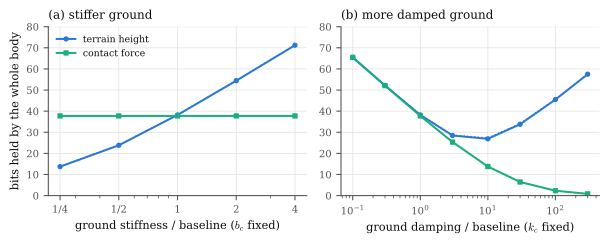
check_designs). The rotor is its angle and velocity; for the rigid leg that is the whole state.
| design | whole body, height | whole body, force | rotor share, height | rotor share, force |
|---|---|---|---|---|
| rigid | 38.21 | 37.74 | 1 | 1 |
| SEA, \(k_s=70\) | 38.21 | 37.74 | 0.063 | 0.060 |
| SEA, \(10^3\) | 38.21 | 37.74 | 0.500 | 0.494 |
| SEA, \(10^4\) | 38.21 | 37.74 | 0.932 | 0.930 |
| SEA, \(10^6\) | 38.21 | 37.74 | 0.995 | 0.995 |
- The design of the body does not change the whole body’s knowledge of height. All designs hold 38.21 bits, as Corollary 9.4 says.
- The rotor’s share is nearly the same for height and force, within 0.007 at every stiffness, as Corollary 9.5 says.
- Stiffness of the ground (Figure 9.3(a)). With \(b_c\) fixed, height bits rise from 13.72 at a quarter of the baseline stiffness to 23.83, 38.21, 54.44 and 71.24 at four times. Force bits stay at 37.742 (
check_contact_sweeps). - Damping of the ground (Figure 9.3(b)). With \(k_c\) fixed, force bits fall from 65.46 at a tenth of the baseline damping to 0.82 at 300 times. Height bits fall from 65.47 to a minimum of 26.90 at 10 times, then rise to 57.50 at 300 times. The band runs to 100 Hz, where \(k_c/\omega=1600\) N s/m, about 2.7 times the baseline; the minimum of the total sits higher because most of the band is at lower frequencies.
- A simple formula predicts all of this. Treating each mode on its own, with signal-to-noise ratio \(\sigma_z^2\Delta t\,(k_c^2+b_c^2\omega_j^2)/(2\sigma_T^2b_c)\) at \(\omega_j=\pi j/T\), gives the dotted curves. It is within 0.5 bits of the height bits and 0.1 bits of the force bits everywhere (
predicted_whole_bits).
9.6 What this chapter shows
For a linear body the chapter gives a complete rule for where information about the environment sits. Push on the part in the best way and add up what each internal damper costs. The path from the contact to the part decides the low-frequency picture. Everything off that path, such as side branches and the far side of the part, matters only in band, through backflow. With several contacts the information becomes a matrix, and it splits into the total load, which internal dampers cannot touch, and the split between the feet, which pays for the path between them. The contact itself decides which environmental property the body can know: its stiffness matters for the ground’s shape and not for the force.
Limits.
- Linear bodies with symmetric \(H\), \(K\), \(D\) and independent viscous dampers. Gyroscopic terms would break the symmetry that reciprocity needs.
- The bench is passive and clamped, with the motor undriven. A part is a set of the body’s own coordinates; how a controller or a sensor would use it is a later question.
- The contact is always engaged and linear: no lift-off, friction or impacts.
- The chains, rods and leg-on-trunk bodies are one-dimensional toys.
Open. More than two contacts, where the split becomes several directions; properties of the environment that change the dynamics themselves, such as the ground’s stiffness or a payload’s mass (roadmap thread T11); and the controlled case, once controllers come into scope.