6.1 Continuum and soft bodies: independence from the mesh
Soft robots and compliant links are modelled by finite elements, where the number of coordinates is a numerical choice. A sound information measure must converge as the mesh is refined.
Theorem 6.1 (Mesh independence) Let a linear elastic body be semi-discretized by conforming finite elements, with consistent mass \(H_N\) and stiffness \(K_N\), and let \(u_N(t)\) be the finite-element field. Then the energy-whitened Gram is \[ G_N^{ij}=\gamma\sum_k\Big[a\big(u^i_{N,k},u^j_{N,k}\big)+m\big(\dot u^i_{N,k},\dot u^j_{N,k}\big)\Big], \] where \(a(\cdot,\cdot)\) is the continuum strain-energy bilinear form and \(m(\cdot,\cdot)\) the continuum kinetic-energy (mass) form. Suppose the finite-element solutions converge in the energy norm at each sample time. This is classical for semi-discrete approximations of damped second-order hyperbolic problems with sufficiently regular data (Dupont 1973; Baker 1976; Geveci 1984); we assume it here. Then \(G_N\to G_\infty\) and the bits converge.
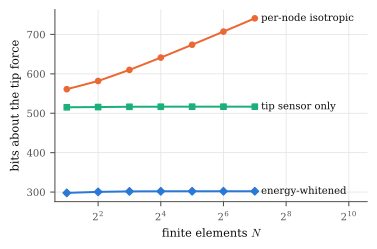
By contrast, per-node isotropic noise has Gram entries \(\approx\frac{N}{L}\times(L^2\text{ inner product})\). It grows linearly in \(N\), so by Proposition 4.3(b) the bits grow like \(\frac r2\log_2N\): about \(\frac r2\) bits per mesh doubling.
Proof. The identity. With \(u_N=\sum_iU_i\psi_i\) in the nodal basis, the finite-element matrices are defined by \(U^\top K_NU'=a(u_N,u_N')\) and \(\dot U^\top H_N\dot U'=m(\dot u_N,\dot u_N')\). Substituting into Equation 1.5 with \(C^\top C=\Em_N\) gives the displayed identity. The nodes have disappeared: the Gram is a sum of continuum energy inner products of the finite-element fields.
Convergence. Each entry is a finite sum (over finitely many \(k\)) of inner products, which are continuous in the energy norm. So energy-norm convergence of each field implies convergence of each entry. Then apply continuity of \(\log\det(I+\cdot)\).
The per-node estimate. For a uniform mesh of spacing \(h=L/N\) and smooth fields, \(\sum_iU_iU_i'\approx h^{-1}\int uu'\,dx\), a Riemann sum.
Remark 6.1 (Cylindrical noise is harmless here). In the continuum limit, isotropic noise in energy coordinates is white noise on the energy Hilbert space. That is a cylindrical measure, not a countably additive one. It does no harm here: the signal \(\{Mw\}\) spans at most \(d\) dimensions, and Lemma 1.1 shows that the information depends only on the \(d\times d\) matrix \(M^\top M\). This is the noise-side counterpart of the requirement, stressed in function-space Bayesian inversion, that priors and inner products be defined so as to survive refinement:
- MCMC proposals that are robust under mesh refinement (Cotter et al. 2013);
- finite-element inner products weighted by the mass matrix (Bui-Thanh et al. 2013, sec. 3.3);
- see also Stuart (2010).
NoteNumerical check
A fixed-free axial rod (length 0.2 m, \(EA=10^3\) N, \(\rho A=0.1\) kg/m, so the first mode is at 125 Hz) with consistent mass, stiffness-proportional damping and a tip force (\(B_w=400\) Hz, \(d=68\)), for \(N=2,\dots,128\) elements (Figure 6.1, check_rod):
- energy-whitened bits converge, \(297.93\to302.109\), changing by \(0.004\) between \(N=64\) and \(128\);
- per-node isotropic bits grow by \(33.2\) bits per doubling, against \(\frac r2=34\) predicted;
- a fixed tip sensor (a physical point sensor) also converges, which shows that the problem is noise per coordinate, not discretization.
6.2 Gear ratios and transmission design
Relabelling a motor angle on the input side of a gear as an angle on the output side is a reparametrization: \(T=\diag(1,1/N)\) in the SEA layout. By Theorem 2.1, energy-whitened bits do not move. Per-coordinate bits jump from 81.37 to 130.91 bits (Figure 2.1).
Changing the gear ratio is a different matter: it changes the reflected inertia \(N^2I_{\rm rot}\), which is a physical change in \(H\). That change enters \(\Em\), and it correctly changes the bits. The energy metric separates bookkeeping from design, which is what a sweep over rotor inertia (such as Table I of Patterson (2026)) needs.
6.3 Floating bases: when a singular metric loses nothing
For an unclamped leg or a free-flying quadruped, \(K\) is singular: rigid-body positions store no energy, while \(H\succ0\) still weighs velocities. The whitened readout \(\Em^{1/2}\), with eigenvalues clipped at zero by sym_sqrt, is blind to zero-energy positions. Does that lose information?
Proposition 6.1 (No loss when force and ground share the Jacobian) Suppose:
- \(K\succeq k_iJ^\top J\) with \(k_i>0\), where \(J\) is the Jacobian through which the unknown force acts;
- \(D\phi=0\) for every \(\phi\in\ker K\). Physically, internal and ground dampers act only on relative or foot motion.
Then, from rest, the trajectory never enters \(\ker K\). More precisely, \(\phi^\top Hq(t)=0\) for all \(\phi\in\ker K\) and all \(t\). On the subspace where the motion lives, \(\Em\) is positive definite, so nothing is lost.
Proof. Step 1: zero-energy modes are not forced. For \(\phi\in\ker K\), \(0=\phi^\top K\phi\ge k_i(J\phi)^2\), so \(J\phi=0\).
Step 2: their coordinates stay at zero. Let \(\eta=\phi^\top Hq\). Multiply Equation 1.1 on the left by \(\phi^\top\): \[ \ddot\eta=(J\phi)^\top f-(D\phi)^\top\dot q-(K\phi)^\top q=0 . \] With \(\eta(0)=\dot\eta(0)=0\), we get \(\eta\equiv0\).
Step 3: \(\Em\) is definite on the motion. By Step 2, \(q(t)\) lies in the \(H\)-orthogonal complement of \(\ker K\). Any nonzero \(q\) in that complement is not in \(\ker K\), so \(q^\top Kq>0\) there.
NoteNumerical check
On the analysis library’s free bench (trunk plus leg, \(q=(y_b,\theta)\)), the energy-whitened and "kinetic" (\(\omega_{\rm ref}^2H\)) readouts give the same bits, 71.709.
The equality has a reason: the motion lives on \(\mathrm{span}(H^{-1}J^\top)\). On that line, \(K\) restricts to \(k_i(JH^{-1}J^\top)^2\) and \(H\) restricts to \(JH^{-1}J^\top\). Their ratio is \(k_i/m_e=\omega_{\rm ref}^2\), where \(m_e\) is the effective mass at the foot, so the two metrics agree on the motion.
A counterexample violates (i) by pushing on the trunk instead of the foot. The zero mode is then forced (\(\phi_0^\top e_1=-0.17\)), and the singular metric loses \(71.86-49.66=22.2\) bits relative to the regularized one (check_floating).
TipWhat this means physically
The quadruped experiments of Patterson (2026, sec. V) apply random pushes \(w_{\rm ext}\) to the calves of a floating quadruped. Those pushes do excite zero-stiffness base positions, so an energy metric built from joint springs alone would discard base-position information. Three remedies:
- keep the base velocities (always weighted, since \(H\succ0\)) and accept that base position is gauge;
- regularize the position block with \(\omega_{\rm ref}^2H\) (the code’s
"kinetic"readout) and report sensitivity to \(\omega_{\rm ref}\); - use the potential of gravity and contact springs at the operating point.
The Zahedi-Ay \(\mathrm{MC}_W\) of Section 5.2 has no Gibbs law when \(\Em\) is singular, which is why morphological_bits correctly refuses the free bench.
6.4 Further uses
- Sensor placement. Definition 5.1 turns “where should the encoder go?” into a Bayesian D-optimal design over physical sensor sites, with noise attached to the body. This is the energy-consistent analogue of effective independence (Kammer 1991; Papadimitriou 2004). Joint-side vs motor-side sensing on the SEA (Figure 5.1) is the simplest instance.
- Variable-stiffness and parallel-elastic actuators, compliant feet. All of these add or remove coordinates as parameters vary. Theorem 4.1 guarantees continuity across the degenerate limits.
- Learned estimators. For InfoNCE, whitening does not change the true information (Lemma 2.1(a)), but it gives the critic dimensionally homogeneous inputs in \(\sqrt{\mathrm J}\). Per-feature \(z\)-scoring is a data-dependent diagonal metric: it is not basis-free, and it changes with the force prior. Noise must be added after whitening, as
sim_infodoes.