2026-11-21: How information about the contact propagates through the body
Question. 8 A thermodynamically consistent body: Langevin noise found that, in a body thermalized by its own dampers, every design holds the same information about the contact force, and designs differ in how much of it a given part of the body holds. What decides how much reaches a part, and what erodes it on the way?
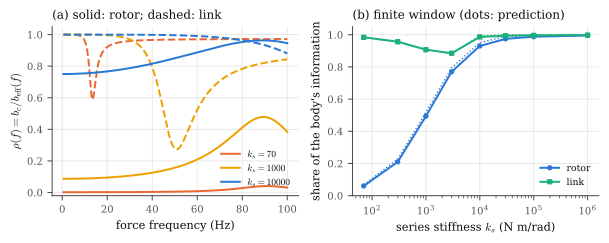
Short answer. A part of the body holds the contact force as if the contact damping were larger than it is: it sees the force through an effective contact damping \(b_{\rm eff}(\omega)\ge b_c\). The ratio \(\rho(\omega)=b_c/b_{\rm eff}(\omega)\), between 0 and 1, is the fraction that propagates to the part at frequency \(\omega\). It falls below 1 for one reason only: thermal noise from dampers inside the body that the force has to cross on its way to the part. Inertia and compliance matter through how they shape that noise at the part. With no internal damper, every part holds everything. On the SEA at \(k_s=70\) the joint-side link holds 98% of the body’s information and the rotor, behind the series damper, holds 6%.
Setting and definitions
Take the Langevin body of 8 A thermodynamically consistent body: Langevin noise: thermal forces with covariance \(2\sigma_T^2D\), started from the Gibbs law. Split the damping into the contact damper and everything else, \[ D=b_c\,J^\top J+D_{\rm int},\qquad D_{\rm int}\succeq0 . \] For the legs in this book \(b_c=b_i=600\) N s/m. For the rigid leg \(D_{\rm int}=0\). For the SEA, \(D_{\rm int}\) is the series damper \(b_s\) acting on the spring deflection.
A part of the body is a set of its coordinates, \(x_P=Px_q\) for a selector matrix \(P\). The rotor’s angle and velocity form one part; the joint-side link’s angle and velocity form another. Nothing is added to \(x_P\): the only noise is the body’s own.
Definition 2 (Effective contact damping) At frequency \(\omega\), let \(h(\omega)=P(i\omega-A)^{-1}B_F\) be the part’s response to the contact force and \(G(\omega)=P(i\omega-A)^{-1}[0;H^{-1}]\) its response to a generalized force. Let \[ M(\omega)=2\sigma_T^2\,G\,D_{\rm int}\,G^* \] be the thermal noise the part receives from the internal dampers, and \(q(\omega)=h^*M^+h\), with \(q=\infty\) when \(h\) lies outside the range of \(M\). The effective contact damping is \[ b_{\rm eff}(\omega)=b_c+\frac{1}{2\sigma_T^2\,q(\omega)}, \] and the spectral share is \(\rho(\omega)=b_c/b_{\rm eff}(\omega)\).
Results
Proof.
The part is a function of the whole state, so data processing gives \(I(w;x_P)\le I(w;x_q)\). For \(\rho\): \(q\ge0\) because \(M\succeq0\), so \(b_{\rm eff}\ge b_c\).
A larger part contains the smaller one’s trajectory, so data processing again gives the inequality for \(\eta\). For \(\rho\), appending rows to \(P\) can only increase \(h^*M^+h\), the signal-to-noise ratio of the best linear combination of the rows.
Under \(q=T\tilde q\) the trajectories and the thermal forces are the same physical signals written in other coordinates (Theorem 2.1), so every information quantity is unchanged. The transfer functions \(h\) and \(G\,D_{\rm int}G^*\) are unchanged for the same reason.
Replacing \(P\) by \(SP\) with \(S\) invertible maps \(h\mapsto Sh\) and \(M\mapsto SMS^*\), which leaves \(h^*M^+h\) unchanged. \(M\) is proportional to \(\sigma_T^2\), so \(\sigma_T^2q\) and hence \(b_{\rm eff}\) do not depend on \(\sigma_T\). The prior does not appear at all.
In the frequency domain a velocity is \(i\omega\) times its coordinate, so the part (coordinate, velocity) has \(h=v\,h_\theta\) and \(M=v\,M_\theta\,v^*\) with \(v=(1,i\omega)^\top\). Then \(M^+=v v^*/(M_\theta|v|^4)\), and \(h^*M^+h=|h_\theta|^2/M_\theta\), the value for the coordinate alone. Thermal noise moves the velocity and the coordinate together, so the velocity adds no independent look at the force.
Theorem 1 (A part holds the force through an effective damper) In the stationary, infinite-window limit, with force spectrum \(S(\omega)\), the information rate held by the part is \[ \dot I_P=\int_0^{\infty}\log\Big(1+\frac{S(\omega)}{2\sigma_T^2\,b_{\rm eff}(\omega)}\Big)\, \frac{d\omega}{2\pi}\ \text{nats/s}, \] and the whole body’s rate is the same expression with \(b_{\rm eff}=b_c\).
Proof. Step 1: the contact damper’s noise enters like the force. The thermal forces have covariance \(2\sigma_T^2D=2\sigma_T^2(b_cJ^\top J+D_{\rm int})\). In law they equal \(J^\top\xi_c+\xi_{\rm int}\), with \(\xi_c\) a scalar white noise of intensity \(2\sigma_T^2b_c\) and \(\xi_{\rm int}\) an independent white noise of covariance \(2\sigma_T^2D_{\rm int}\). Since \(f\) also enters through \(J^\top\), the part’s trajectory is \[ x_P=h\,(f+\xi_c)+G\,\xi_{\rm int} . \]
Step 2: one frequency. At each frequency this is a scalar Gaussian signal \(f\) in Gaussian noise of spectral density \(N=2\sigma_T^2b_c\,hh^*+M\). The information rate of a stationary Gaussian signal in independent stationary Gaussian noise is the integral of \(\log(1+S\,h^*N^{-1}h)\) over frequency (Cover and Thomas 2006, Ch. 9).
Step 3: Sherman-Morrison. With \(u=\sqrt{2\sigma_T^2b_c}\,h\), \((M+uu^*)^{-1}=M^{-1}-M^{-1}uu^*M^{-1}/(1+u^*M^{-1}u)\), so \[ h^*N^{-1}h=\frac{q}{1+2\sigma_T^2b_c\,q}=\frac{1}{2\sigma_T^2b_c+1/q} =\frac{1}{2\sigma_T^2b_{\rm eff}} . \] When \(M\) is singular the same holds with \(M^+\), and \(q=\infty\) gives \(b_{\rm eff}=b_c\).
Step 4: the whole body. With \(P=I\), \(h=G\,J^\top\) and \(M=2\sigma_T^2GD_{\rm int}G^*\). The matrix \(G=(i\omega-A)^{-1}[0;H^{-1}]\) has full column rank, so \(h\) lies in the range of \(M\) exactly when \(J^\top\) lies in the range of \(D_{\rm int}\). For the rigid leg \(D_{\rm int}=0\). For the SEA its range is spanned by \((1,-1)\), which does not contain \(J^\top=(-r,0)\). So \(q=\infty\) and \(b_{\rm eff}=b_c\), consistent with Proposition 8.2.
Corollary 1 (No internal damper, no loss) If the only damper is at the contact (\(D_{\rm int}=0\)) and \(h(\omega)\ne0\) over the force band, then \(\rho\equiv1\): every part holds everything the body holds. In the rigid leg the rotor’s angle alone holds the full ceiling, and so does its velocity alone.
Proof. \(M=0\), so \(h\) lies outside the range of \(M\) wherever \(h\ne0\), and \(b_{\rm eff}=b_c\).
Proposition 2 (The SEA’s rotor and link) For the clamped SEA with series damping \(b_s=2\zeta_s\sqrt{k_sI_{\rm rot}}\), \(m_j=m_lr^2\) and \(c=k_s+ib_s\omega\), \[ \rho_{\rm rotor}=\Big[1+\frac{b_s}{b_c}\, \frac{|k_ir^2-m_j\omega^2+i\omega b_cr^2|^2}{r^2|c|^2}\Big]^{-1},\qquad \rho_{\rm link}=\Big[1+\frac{b_s}{b_c}\, \frac{I_{\rm rot}^2\omega^4}{r^2|c-I_{\rm rot}\omega^2|^2}\Big]^{-1}. \]
Proof. By Proposition 1(e) it is enough to work with each part’s angle.
Step 1: the impedance matrix. With \(z_g=k_ir^2+i\omega b_cr^2-m_j\omega^2\) the joint-side impedance, the clamped equations read \(Z q=J^\top f+\dots\) with \(Z=\left[\begin{smallmatrix}z_g+c&-c\\-c&-I_{\rm rot}\omega^2+c\end{smallmatrix}\right]\) and \(\Delta=\det Z\), so \(Z^{-1}=\Delta^{-1}\left[\begin{smallmatrix}-I_{\rm rot}\omega^2+c&c\\c&z_g+c \end{smallmatrix}\right]\).
Step 2: the two inputs. The contact force enters as \(J^\top=(-r,0)\). The series damper acts on the deflection, so its noise enters as \(a_s=(1,-1)\) with intensity \(2\sigma_T^2b_s\).
Step 3: the rotor is row 2 of \(Z^{-1}\): \(h=-rc/\Delta\) and \(h_s=(c-z_g-c)/\Delta=-z_g/\Delta\). With one coordinate, \(1/(2\sigma_T^2q)=b_s|h_s|^2/|h|^2=b_s|z_g|^2/(r^2|c|^2)\).
Step 4: the link is row 1: \(h=-r(c-I_{\rm rot}\omega^2)/\Delta\) and \(h_s=(c-I_{\rm rot}\omega^2-c)/\Delta=-I_{\rm rot}\omega^2/\Delta\), which gives \(b_s|h_s|^2/|h|^2=b_sI_{\rm rot}^2\omega^4/(r^2|c-I_{\rm rot}\omega^2|^2)\).
The two formulas say where the series damper’s noise lands. The rotor sits behind the damper, so it receives the damper’s noise against the force filtered through the spring, and a soft spring makes that filter weak. The link sits on the contact side. Its losses come only near the rotor resonance \(\sqrt{k_s/I_{\rm rot}}\), where the rotor swings and pumps the damper’s noise back through the spring.
Proposition 3 (At low SNR, the share is the band average of rho) With a flat force spectrum over \([0,B]\) and whole-body SNR \(\mathrm{snr}=S/(2\sigma_T^2b_c)\), the infinite-window share is \(\eta=\int_0^B\log(1+\mathrm{snr}\,\rho)\,df\big/\big(B\log(1+\mathrm{snr})\big)\), and \(\eta\to\frac1B\int_0^B\rho\,df\) as \(\mathrm{snr}\to0\).
Proof. The formula for \(\eta\) is Theorem 1 divided by its whole-body value. As \(\mathrm{snr}\to0\), \(\log(1+\mathrm{snr}\,\rho)/\log(1+\mathrm{snr})\to\rho\) for each \(f\), and the ratio is bounded by 1, so the limit passes inside the integral (dominated convergence).
So \(\rho(\omega)\) describes the body and the part without reference to a noise level or a force prior, and \(\eta\) is that description at a stated SNR. A larger SNR compresses the losses, because the logarithm saturates.
Numbers
| \(k_s\) (N m/rad) | rotor, finite | rotor, predicted | link, finite | link, predicted |
|---|---|---|---|---|
| 70 | 0.060 | 0.068 | 0.984 | 0.985 |
| \(10^3\) | 0.494 | 0.518 | 0.907 | 0.910 |
| \(10^4\) | 0.930 | 0.951 | 0.986 | 0.994 |
| \(10^6\) | 0.995 | 1.000 | 0.998 | 1.000 |
- The state-space computation and the closed forms agree to \(7\times10^{-16}\), and \(\rho\) is unchanged, to \(4\times10^{-16}\), under every reparametrization of Figure 2.1 (
check_closed_forms,check_reparametrization). - The finite-window share sits up to 0.025 below the prediction. The gap comes from the window’s edges and from the Gibbs initial state, and shrinks as \(k_s\) grows (
check_prediction). - Series damping is the loss. At \(k_s=70\), lowering \(\zeta_s\) from 0.1 to 0.03 to 0.01 raises the rotor’s share from 0.060 to 0.095 to 0.200, while the whole body stays at 37.742 bits (
check_series_damping). - At low SNR the share tends to the band average of \(\rho\): 0.221 for the rotor at \(k_s=10^3\), against 0.518 at the book’s SNR (
check_low_snr_limit).
What this changes
8 A thermodynamically consistent body: Langevin noise reported that the share held by the SEA’s rotor climbs from 6% to 99.5% with stiffness. The link of the same SEA holds 91% to 99.8% at every stiffness tested (Figure 1(b)). Where the information sits in the body is decided by where the internal dampers sit: a part on the contact side of the dissipation holds the force, and a part behind it holds what survives the damper’s thermal noise. Compliance changes this only through how it filters the force and that noise on the way to each part.
Limits of this note
- The bench is passive and clamped, with the motor undriven. A part here is a set of the body’s own coordinates. How a controller or a sensor would use a part is outside the scope of this note.
- Damping is viscous and constant.
- The rate formula in Theorem 1 is the standard infinite-window result. The finite-window numbers are computed directly and agree with it to within 0.025.
Next steps
- A chain of masses, springs and dampers, and the rod of Theorem 6.1: how the share falls with the number of dampers between the contact and a part.
- The spring deflection, which is a part that mixes the rotor and the link.
- Once this is settled, fold the note into 8 A thermodynamically consistent body: Langevin noise.