2026-11-21: How information spreads along a chain
Question. The note on propagation showed that a part of the body holds the contact force through an effective contact damping \(b_{\rm eff}(\omega)\ge b_c\), raised by the internal dampers. On the SEA there is one internal damper and two parts. What happens in a body with many dampers between the contact and a part, such as a chain of masses or a rod?
Short answer. Shake the body at the part. Each internal damper then adds its damping times the square of its stretch per unit motion of the contact point to \(b_{\rm eff}\). This follows from reciprocity and holds for any linear body with symmetric mass, stiffness and damping. In a chain, the cost of a damper between the contact and the part is the same for every part beyond it, so these costs only accumulate with distance. Dampers beyond the part add a second cost, which we call backflow. At low frequency backflow vanishes and each damper on the way costs \(b_j(k_c/k_j)^2\), where \(k_c\) is the contact stiffness and \(k_j\) the damper’s spring. Information therefore crosses a stiff interior well and a soft one badly. In band, the backflow can dominate: on a rod the contact point itself holds the least, because it loses near the natural frequencies of the body held fixed at the contact.
Setting
The body has symmetric \(H\), \(K\) and \(D\), and its dampers are independent: \[ D=b_c\,J^\top J+\sum_j b_j\,a_ja_j^\top , \] where damper \(j\) resists the velocity \(a_j^\top\dot q\) with coefficient \(b_j\). A part is one combination of coordinates \(y=p^\top q\), such as a node or a spring’s deflection. By Proposition 1(e) of the propagation note its velocity adds nothing, so one row is enough. The dynamic stiffness at frequency \(\omega\) is \[ Z(\omega)=K-\omega^2H+i\omega D , \] and \(Z(\omega)^{-1}\) maps a harmonic force to the harmonic displacement it produces. This is the position block of \((i\omega-A)^{-1}[0;H^{-1}]\) in Definition 2 of the propagation note.
A chain has node 0 at the contact, where the force acts and the ground holds it through a spring \(k_c\) and a damper \(b_c\). Element \(j\) joins node \(j\) to node \(j+1\) with a spring \(k_j\) and a damper \(b_j\), so \(a_j=e_j-e_{j+1}\). The far end is free.
Results
Theorem 1 (Shake the body at the part) Let \(w(\omega)=Z(\omega)^{-1}p\) be the body’s response to a unit harmonic force applied at the part. Then \[ b_{\rm eff}(\omega)=b_c+\sum_j b_j\,\frac{|a_j^\top w|^2}{|Jw|^2}. \]
Proof. Step 1: the two responses. At frequency \(\omega\) the part responds to the contact force with \(h=p^\top Z^{-1}J^\top\) and to the noise force of damper \(j\), which enters along \(a_j\), with \(p^\top Z^{-1}a_j\).
Step 2: the definition. The dampers are independent, so the noise the part receives from them is \(M=2\sigma_T^2\sum_jb_j|p^\top Z^{-1}a_j|^2\). With one coordinate, \(q=|h|^2/M\), and the definition of \(b_{\rm eff}\) gives \[ b_{\rm eff}-b_c=\frac{1}{2\sigma_T^2q}=\sum_jb_j\,\frac{|p^\top Z^{-1}a_j|^2}{|p^\top Z^{-1}J^\top|^2}. \]
Step 3: reciprocity. \(Z\) is a symmetric complex matrix (not Hermitian), so \(Z^{-1}\) is symmetric too. Hence \(p^\top Z^{-1}a_j=a_j^\top Z^{-1}p=a_j^\top w\) and \(p^\top Z^{-1}J^\top=JZ^{-1}p=Jw\). This is the Maxwell-Betti reciprocity theorem of structural mechanics: the response at the part to a force at the damper equals the damper’s stretch under a force at the part.
The formula turns a question about noise into a question about one forced motion. Push on the part and watch the body: a damper that stretches a lot while the contact point barely moves is expensive. The numerical check uses 20 random chains with 2 to 8 nodes and parameters spread over several decades, plus the SEA’s rotor, link and spring deflection. The formula and the state-space computation of \(b_{\rm eff}\) agree to \(4\times10^{-14}\) on the chains and \(10^{-10}\) on the SEA (check_reciprocity).
Corollary 1 (Costs accumulate along a chain) In a chain, take a part at node \(k\) and an element \(j<k\), which lies between the contact and the part. Its cost \(|a_j^\top w|^2/|w_0|^2\) is the same for every part \(k>j\). So \[ b_{\rm eff,k}=b_c+\sum_{j<k}b_j\,c_j+B_k , \] where \(c_j\) does not depend on \(k\), and the backflow \(B_k\) collects the elements beyond node \(k\).
Proof. \(w\) solves \(Zw=e_k\), and \(Z\) is tridiagonal. Rows \(0,\dots,k-1\) of this system have zero on the right. Row 0 reads \(Z_{00}w_0+Z_{01}w_1=0\), which fixes \(w_1/w_0\); the off-diagonal entry \(Z_{01}=-(k_0+i\omega b_0)\) is nonzero. Each further row \(i\le k-1\) fixes \(w_{i+1}\) from \(w_{i-1}\) and \(w_i\). So the ratios \(w_1/w_0,\dots,w_k/w_0\) come from rows that do not involve \(k\), and \((w_j-w_{j+1})/w_0\) is the same for every \(k\ge j+1\).
The ratio \(|a_j^\top w|^2/|w_0|^2\) agrees across parts to \(10^{-14}\) on the uniform chain below (check_accumulation). Once information has been lost crossing a damper, no part farther along gets it back. The share can still rise along the chain, because the backflow \(B_k\) shrinks as fewer dampers lie beyond the part.
Proposition 1 (The static law) In a chain with a free far end, \[ \rho_k(0)=\frac{b_c}{b_c+k_c^2\sum_{j<k}b_j/k_j^2}. \]
Proof. At \(\omega=0\), \(Z=K\), which is invertible because the contact spring anchors the chain, and \(w\) is the static deflection under a unit force at node \(k\).
- The segment beyond node \(k\) is free and unloaded, so its springs carry no force and \(a_j^\top w=0\) for \(j\ge k\). The backflow is zero.
- Every element between the contact and node \(k\) carries the whole unit force, so it stretches by \(1/k_j\).
- The contact spring carries it too, so \(w_0=1/k_c\).
Theorem 1 then gives \(b_{\rm eff,k}(0)=b_c+\sum_{j<k}b_j\,k_c^2/k_j^2\).
Each damper on the way costs \(b_j(k_c/k_j)^2\). Since \(b_j/k_j\) is the damper’s relaxation time, this cost is the relaxation time multiplied by \(k_c^2/k_j\): it grows with slow dampers and with springs that are soft compared with the contact. For the SEA’s rotor, in joint coordinates where the contact has stiffness \(k_ir^2\) and damping \(b_cr^2\), the law gives the cost \(b_s(k_ir^2/k_s)^2\), the low-frequency limit of the rotor formula in the propagation note. On 20 random chains the law matches \(\rho_k\) at \(10^{-4}\) Hz to \(2\times10^{-10}\) (check_static_law).
For a rod with Kelvin-Voigt material damping \(D=cK\), an element of length \(h\) has \(k_e=EA/h\) and \(b_e=c\,EA/h\), so it costs \(c\,k_c^2h/EA\). The elements between the contact and a point at distance \(x\) add up to \[ \rho(x,0)=\frac{b_c}{b_c+c\,k_c^2\,x/EA}, \] which does not depend on the mesh.
Remark 1 (Where the contact point loses). For the part at the contact node, \(w=Z^{-1}e_0\), and by Cramer’s rule \(w_0=\det Z_c/\det Z\), where \(Z_c\) is \(Z\) with row and column 0 removed: the dynamic stiffness of the body held fixed at the contact. Near a natural frequency of that clamped body, \(\det Z_c\) is small (zero without internal damping). The rest of the body then rings while the contact point hardly moves, and the cost in Theorem 1 becomes large. On the SEA, the clamped body is the rotor on its spring, which is why the link loses near \(\sqrt{k_s/I_{\rm rot}}\).
Numbers
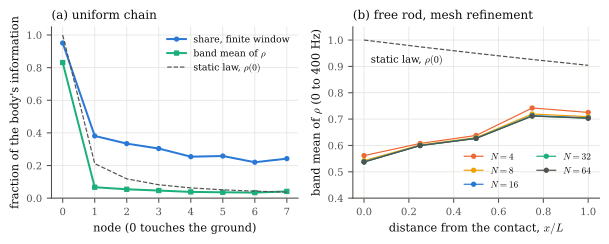
Two bodies. The uniform chain has eight 0.1 kg masses, springs of \(10^4\) N/m, dampers at 5% of critical per element, and a contact ten times stiffer than one element (\(k_c=10^5\) N/m, \(b_c=84.9\) N s/m, 15% of critical on the chain’s mass). Its modes lie between 10 and 168 Hz, and the whole body holds 61.23 bits about a 100 Hz force profile. The rod is free at both ends and touches the ground at one: \(L=0.2\) m, \(EA=10^3\) N, \(\rho A=0.1\) kg/m, Kelvin-Voigt damping at 5% of critical on the first free-free mode, \(k_c=EA/L\) and \(b_c=3\) N s/m.
check_chain_shares).
| Node | 0 | 1 | 2 | 3 | 4 | 5 | 6 | 7 |
|---|---|---|---|---|---|---|---|---|
| share, finite window | 0.951 | 0.381 | 0.334 | 0.304 | 0.254 | 0.258 | 0.220 | 0.242 |
| band mean of \(\rho\) | 0.831 | 0.067 | 0.054 | 0.047 | 0.038 | 0.036 | 0.034 | 0.041 |
| static law \(\rho(0)\) | 1 | 0.212 | 0.118 | 0.082 | 0.063 | 0.051 | 0.043 | 0.037 |
- The first damper costs most. The contact is ten times stiffer than one element, so each damper costs \(b_j(k_c/k_j)^2=100\,b_j\) statically, about four times \(b_c\). The share drops from 0.951 at the contact node to 0.381 one node in, then declines slowly.
- The free end beats its neighbour. Node 7 holds 0.242 and node 6 holds 0.220. Node 7 has no damper beyond it, so its backflow is zero; node 6 still receives the last damper’s noise from behind.
- The finite-window share sits far above the band mean of \(\rho\). The whole-body SNR is 147 per band, and the logarithm in Proposition 3 of the propagation note compresses the losses.
- The rod converges under mesh refinement. From 32 to 64 elements the band mean of \(\rho\) changes by at most \(4\times10^{-4}\) at every position, and the static values match the formula above to \(10^{-6}\) on every mesh (
check_rod_mesh). - On the rod the contact point holds the least. The band mean of \(\rho\) is 0.537 at the contact and rises to 0.711 at \(x=0.75L\) and 0.703 at the far end, while the static law falls from 1 to 0.904. The contact node’s \(\rho\) dips to 0.012 at 125.1 Hz and to 0.092 at 377.5 Hz; the rod clamped at the contact has its modes at 125.0 and 375.3 Hz (
check_contact_dips). The chain’s two deepest dips sit at 10.53 and 31.13 Hz, against clamped modes at 10.52 and 31.11 Hz.
The SEA’s spring deflection
Proposition 2 (The deflection holds the force only through the rotor) For the clamped SEA with the motor undriven, the spring deflection \(\delta=\theta_j-\theta_m\) has \[ \rho_\delta=\Big[1+\frac{b_s}{b_c}\, \frac{|k_ir^2-m_j\omega^2+i\omega b_cr^2-I_{\rm rot}\omega^2|^2}{r^2I_{\rm rot}^2\omega^4}\Big]^{-1}, \] which tends to 0 as \(\omega\to0\). The spring stiffness \(k_s\) enters only through \(b_s\).
Proof. Apply Theorem 1 with \(p=(1,-1)\): equal and opposite torques across the spring. With \(z_g=k_ir^2+i\omega b_cr^2-m_j\omega^2\) and \(c=k_s+i\omega b_s\), \(Zw=p\) reads \[ (z_g+c)w_0-c\,w_1=1,\qquad -c\,w_0+(c-I_{\rm rot}\omega^2)w_1=-1 . \] Adding the two rows gives \(z_gw_0=I_{\rm rot}\omega^2w_1\). The damper’s stretch is \(w_0-w_1=w_0(I_{\rm rot}\omega^2-z_g)/(I_{\rm rot}\omega^2)\) and the contact moves by \(Jw=-rw_0\), so the cost is \(b_s|z_g-I_{\rm rot}\omega^2|^2/(r^2I_{\rm rot}^2\omega^4)\). Neither expression contains \(c\), so \(k_s\) appears only inside \(b_s\).
Pinching the spring with equal and opposite torques barely moves the foot when the rotor is free, because the rotor’s inertia is the only thing the spring can push against. So the deflection follows the contact force only through the rotor’s acceleration, which vanishes at low frequency. Its share falls with stiffness, from 0.566 at \(k_s=70\) to 0.463 at \(10^3\) and 0.362 at \(10^4\) (predicted 0.597, 0.492, 0.389), because a stiffer spring at fixed damping ratio has a larger \(b_s\). The closed form matches the state-space computation to \(10^{-15}\) (check_deflection). A driven motor changes this, since the motor torque then also balances the spring.
What this changes
The propagation note found that internal dampers decide where the information sits. This note gives the rule for any linear body: shake it at the part and weigh each damper’s stretch against the contact point’s motion. In a chain, losses on the way to a part accumulate and are never recovered. Statically they are set by \(k_c^2\sum b_j/k_j^2\), so a body that is stiff inside compared with its contact keeps the force intact. In band, the dampers beyond a part also matter, and the contact point itself can be the worst place to hold the force, near the modes of the body held fixed at the contact.
Limits of this note
- Linear bodies with symmetric \(H\), \(K\), \(D\) and independent viscous dampers. Gyroscopic terms would break the symmetry used in Theorem 1.
- One-coordinate parts. A part with several independent coordinates needs the matrix version of the formula.
- The far end of the chain is free, as for an undriven rotor. A clamped far end adds a static backflow.
Next steps
- The matrix version of Theorem 1 for parts with several coordinates.
- Trees: a body that branches, such as a leg attached to a trunk with other legs.
- Fold this note and the propagation note into 8 A thermodynamically consistent body: Langevin noise.